Hogging the Market

May 18, 2012

Technically these are pigs, not hogs.

Because of a mild winter, the country’s burgeoning hog population has, well, porked up. The increase in hogs has led to a decrease in wholesale prices, but consumers have yet to benefit from discounted pork products at restaurants and supermarkets. Retailers have yet to lower prices and in the midst of a struggling economy, this is leading to less pork consumption.

As Marshall Eckblad reports in the Wall Street Journal:

[R]etailers are keeping prices higher, in large part because some anticipate wholesale prices eventually will rise, said Jim Robb, director of the Livestock Marketing Information Center in Denver, a cooperative that includes representatives from academia, the government and the meat trade.

Costco Wholesale Corp. (COST) spokesman Jeff Lyons said retailers like Costco are loath to lower prices until they are sure they can make up for the discounts with higher volumes. Costco has discounted some popular pork ribs, Mr. Lyons said, though has offset that by keeping prices of loins and chops high.

“The problem with deflation is your sales have to be really high to cover your expenses,” Mr. Lyons said. “We’re trying to keep everything moving, for the vendor and for ourselves.”

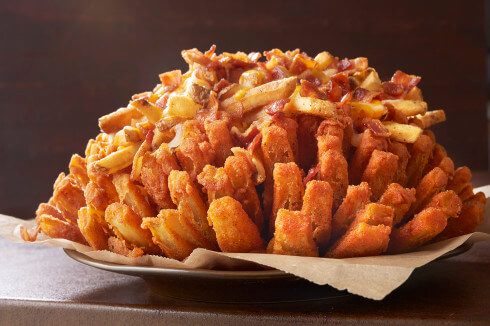
The COO of Tyson Foods is quoted saying, “High-priced bacon actually decreased consumption.” And yet all around I see bacon—from the Wendy’s Baconator to Morton’s Steakhouse Bacon-Loaded Cheeseburger (for the latter, the bacon is inside the burger). What would the world be like if retail prices actually dropped? Would we have bacon-flavored milkshake? Oh wait, we already do.

1 comment

Washington Post food columnist Tim Carman found this nugget in the Joe Bastianich memoir, Restaurant Man:

There is no doubt that I invented the “everything bagel.” … This is where stoner mentality meets Restaurant Man’s instinct to be cheap and find ways to use [expletive] you would normally throw out in order to innovate and create a superior product.

When you bake bagels, first you boil them, then you put them on wooden slats, and then you blast them with whatever is their destiny in life: poppy seeds, sesame seeds, that weird onion [expletive], whatever. Underneath the slats is like a big metal trough that catches everything that doesn’t stick to the bagel, which quickly becomes a mess of poppy seeds, sesame seeds, that weird onion [expletive], and everything else. You can see where this is going. One stoned day your newly minted bagel baker was just stoned enough to see the future—and voila, everything bagels. Thank you.

Except, as Carman points out, others have claimed to have invented the “Everything Bagel,” as far back as at least 1977. And we may never know who did it first, just as we will never know who invented the hamburger—was it in Wisconsin or Connecticut or during a World’s Fair? (I personally eliminate Connecticut since the place that makes the claim—Louis’ Lunch in New Haven—concocted, in fact, a patty melt, which I consider distinct from a burger.)

0 comments

Drink Responsibly

May 16, 2012

Benjamin Wallace, author of The Billionaire’s Vinegar, has a terrific piece in New York Magazine about Rudy Kurniawan, the young wine collector whose cellar included some of the rarest bottles imaginable, such as a 1945 DRC Romanée-Conti and a case of 1959 Roumier Musigny. Kurniawan once auctioned off 2,310 lots for more than $24 million.

But oenologists had their suspicions.

[T]wo bottles left [Paul Wasserman] scratching his head. The 1947 lacked the unctuousness of right-bank Bordeaux from that legendary vintage, and the 1961 struck him as “very young.” He briefly entertained the idea of “possible fakes”—’61 Pétrus in magnum has fetched up to $28,440 at auction—and jotted, in his notes on the ’47, “If there’s one bottle I have serious doubts about tonight, this is it.”

Not only that, writes Wallace, but “you really had to wonder about the bottles of 1923 Roumier Bonnes-Mares included in the sale. The domain was founded in 1924.”

It seems that Kurniawan was part wine lover and part Willem Dafoe’s character in To Live and Die in L.A.

(Hat tip JVL)

0 comments

On Charcuterie

May 15, 2012

According to the Oxford Companion to Food, charcuterie “literally means cooked meat, from the French chair cuit. It now refers almost solely to pork products, which are sold by a specialist charcutier and include hams, sausages, sausage meat, and forcemeats…” For many of us, charcuterie is a section on menus at trendy restaurants we’ve only begun to notice in the last several years. Ten years ago, where did all that forcemeat go?

By and large it didn’t exist. But there’s been a surge of late—both in consumers who seek out housemade terrines and pâtés that appeal to their more adventurous side as well as in chefs who want to use every part of a pig and who yearn to be artisans. Michael Ruhlman has written a book, Charcuterie: The Craft of Salting, Smoking and Curing, coauthored by Brian Polcyn. And in last week’s Washington Post, Cathy Barrow profiled chef and butcher Jason Story, who makes his own sopressata, tasso, and the like, right in Petworth:

“Nobody, not once, showed me how to do this,” [Story] says, wiping the blade of his knife with a clean towel.

While restaurant chefs enhance their menus with house-made, artisanal meats, culinary schools are just beginning to respond with the broader kind of training required. Most of the schools in the States educate students on the cuts of meat, portioning and buying, as well as garde manger, literally “keep to eat,” which includes pâtés and fresh sausages. But one chef said that a chicken was the only animal he learned to break down at culinary school; another said about 31/2 hours were devoted to learning those familiar charts of meat cuts.

But will we start seeing a rise in butcher shops? Local butchering fell into decline because of supermarkets—a convenient source of one-stop shopping where most of the meats have already been precut (as noted in Barrow’s article). Roger Horowitz notes in Putting Meat on the American Table that based on the 1929 census, there were 44,000 butcher shops nationwide. Today, there are a handful of places in the D.C. area (Wagshal’s, the Organic Butcher, for example). It will be interesting to see where all this leads us (or won’t lead us, depending on the economy).

Photo note: I took this picture in 2009 at a Schlemmermeyer’s display case in Stuttgart. Quite literally a sausagefest.

0 comments

CityZen Soldiers

May 13, 2012

I’ve never been to CityZen over at the Mandarin Oriental in southwest D.C., but it’s racked up stars and critical acclaim ever since it opened. Not that we should be surprised—at the helm is Eric Ziebold, an eight-year French Laundry veteran and James Beard Award winner. Sarah Kaufman over at the Washington Post has an impressively long essay on the inner workings of CityZen, which is akin to watching a ballet:

In the kitchen, eight cooks are squeezed together like a submarine crew. Still, they swivel with ease from slicing to stirring, swinging stockpots onto burners, bending down to haul meat out of the lowboy fridge and springing back up to toss it into a pan.

Ryan Zimmerman fielding a grounder and firing it to first base has nothing on these toqued commandos, who glide through the same motions again and again. They’re a hairbreadth from ruin, mere seconds away from scorched shoat, lost lamb, overdone duck. All that separates them from expensive errors and trips to the hospital is timing, rehearsal and reflexive grace.

Two sous-chefs oversee the meat and fish orders: bearded, ponytailed Michael Malyniwsky and tall, slender Kerwin Tugas, who slips like an eel between the other cooks. Mike O’Brien, the meat cook, is the one with fingers full of bandages. The workhorses are the appetizer guys: Aleksandr Felickson, who assembles the cold plates of pickled shad or pink sashimi with a jeweler’s precision, and gangly Alex Brown, a one-man band of pots, whisks, spoons and saucepans, who makes the hot starters—the soft-boiled egg with gourmet scrapple and gravy, the risotto, the soup.

Tickets roll out of a machine on the counter. Ziebold tears them off and calls out the orders. He has a calm, smooth way of moving, no rushing, no lurching. He wields a long spatula like a conductor’s baton.

“Three egg, three tartare!”

Fun reading, if you’re into this sort of thing.

0 comments